



Hope Is Not the Problem. Idling in It Is.
The rest is still unwritten.
I love that phrase. I love the permission it gives, the openness of it, the idea that the story is not over and the best chapters are still ahead. There is real power in that kind of hope. It is the thing that keeps you moving on the hard days, that reminds you the window has not closed, that the life you keep imagining is not out of reach.
But hope has a shadow side that almost nobody talks about. And it is this: hope is extremely comfortable. So comfortable that you can spend years inside it without ever actually moving.
The guru inspo weekend gives you hope. The retreat gives you hope. The book about the writer who did not get started until she was fifty gives you hope. And every single one of those things is genuinely valuable if it gets you inspired enough to take one real action the following Monday. The problem is when the hope itself becomes the destination. When gathering stories of other people who changed their lives becomes a substitute for taking the first step toward changing yours.
That is the trap. And the only way out of it is action, today, in real life, with real bounce backs.
Why Action Today Is the Whole Game
Here is what I discovered, after twenty years of methodologies and programs and retreats and therapists and guru books: the only thing that actually moved my life forward was taking action in real life today. Not planning to take action. Not ideating around the action. The actual doing of the thing, imperfectly, incompletely, in the middle of a real Tuesday.
And the reason action today is so critical is not just about momentum. It is about information. When you take real action toward a real goal, the world bounces back at you immediately. You find out that this is harder than you thought. You find out that the path you imagined has a wall in it you did not know was there. You find out which people in your life actually support what you are building and which ones have been depending on you to keep your goals quietly on hold so their needs can stay first.
None of that information is available to you from inside the hope. It only arrives when you move.
That is why I got fierce about action. Not because I am naturally disciplined. Because I tracked year after year of delaying, and I could see in real data that the delays had real costs, and the costs were accumulating in a direction I did not want to keep going.
The 28-Day Notebook: A Diagnostic Tool, Not a Planning Tool
KindEdge Step 1 is not a vision board. It is not a detailed project plan. It is not a digital tool or an app or a system that requires setup time before you can use it.
It is a binder. A physical binder. With paper in it.
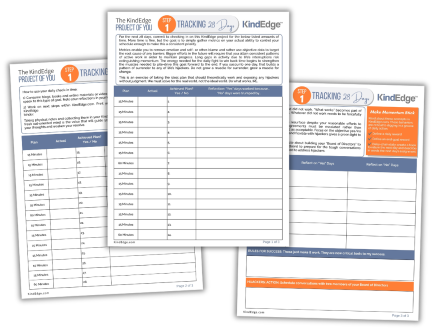
Here is the assignment: for 28 days, can you protect 15 minutes every day for the Project of You? That is it. Not an hour. Not a full Saturday. Fifteen minutes, tracked on paper, in a binder that sits on your desk and takes up physical space in your life.
In those fifteen minutes you gather. You read about someone who did what you want to do. You write down what the next possible step might be. You sketch the outline of the idea. You make one note that did not exist yesterday. The content of the fifteen minutes matters less than the consistency of protecting them.
But here is where the diagnostic function becomes visible. Track what gets in the way when you cannot protect those fifteen minutes. The babysitter who did not show up. The employer who manufactured a Friday evening urgency. The spouse who did not honor the agreement you made. The landscaper who left the palm fronds and somehow that became your problem at 6:00 p.m.
Three days in a row where the fifteen minutes got hijacked is not a scheduling failure. It is data. It is telling you exactly which people, systems, and commitments in your current ecosystem are not compatible with the life you are trying to build. And that data is worth more than any planning session, because it is specific to your actual life rather than an imagined one.
The Babysitter, the Employer, the Palm Fronds: Reading Your Hijacker Data
When I say the fifteen minutes is a diagnostic tool, here is what I mean in practice.
Say you negotiated fairly and honestly with your spouse that from 8:00 to 8:15 every evening, that window belongs to the Project of You. Other household matters, including the children, are handled during that time. You agreed. It is real and documented.
And then the babysitter does not show up. Three times. And each time, the fifteen minutes is the thing that gets eaten.
That is not bad luck. That is a system problem. The babysitter is unreliable, and because you have not replaced them, the unreliability is now a recurring tax on the thing you say matters most. The solution is not to be more flexible. The solution is to get a reliable babysitter, because this is the Project of You and it is not optional.
Same with the employer who keeps saying yes to the modified work schedule you have been asking for, just not yet, just not this quarter, just not now. Six months of just not now is a no. And a no means you need to decide: is this employer compatible with the life I am building? Because the data is telling you the answer, and the answer is not comforting.
This is what action today reveals that hope never can. It shows you your actual ecosystem with ruthless clarity. And once you can see it clearly, you can make real decisions about it.
Become a Time Tyrant
I want to give you a title and I want you to take it seriously. You are a time tyrant now. Not a time manager. Not someone who tries to fit in their goals when the schedule allows. A tyrant about your time.
What that means practically:
- The fifteen minutes are non-negotiable. Not flexible. Not negotiable. They belong to the Project of You and they are protected with the same seriousness as any other commitment that has consequences if you miss it.
- Hijackers get addressed, not accommodated. The unreliable babysitter gets replaced. The employer who will not honor the agreement gets a firm timeline or a job search. The palm frond situation gets fixed at the system level so it stops stealing minutes.
- Hope is rationed deliberately. You allow yourself one retreat, one inspiring video, one guru book, and then you return to action. Hope fuels you enough to take the next step. It does not replace the step.
- The notebook is always with you. Not because it looks good. Because it is the physical evidence that this is real, that the Project of You has a name and a space and a daily commitment attached to it.
Becoming a time tyrant is not selfishness. It is the only responsible relationship you can have with the finite number of minutes you have left. Every minute you give away to something that is not moving your life forward is a minute that is gone permanently. The time tyrant knows this and acts accordingly.
The Rest Gets Written One Fifteen-Minute Block at a Time
The rest of your story is still unwritten. That is genuinely true. But it does not write itself. It gets written in the fifteen-minute blocks you protect on Tuesday evenings when everything else is trying to claim them. It gets written in the negotiation you have with your employer this week rather than deferring it again to next month. It gets written in the decision to replace the babysitter, update the resume, or renegotiate the club membership that is consuming time you do not have.
Start with the binder. Download the 28-day worksheet. Give the Project of You a name. Put it on paper and put it somewhere you will see it.
And then protect fifteen minutes tomorrow. Not next Monday. Tomorrow. Because the rest only gets written if you start writing it today.
Join me at kindedge.com. It is not going to be easy. But it is going to be fun.
Want to go deeper?Subscribe to the KindEdge community — a growing group of people taking realdaily steps toward the life they actually want: kindedge.com/subscribe
And if you'd ratherlisten than read, the latest video is waiting for you: youtube.com/@kindedge