



The Perfect Path Does Not Exist
When you set out to achieve something difficult, something new, something that requires real change in your life, the instinct is to find the perfect plan first. The right sequence. The right timing. The right conditions. The right order of steps that will take you cleanly from where you are to where you want to be.
That plan does not exist. And the pursuit of it is exactly what keeps most people from achieving the big goal they keep saying they want.
Here is the truth: you cannot plan your way to something you have never done before, because you do not yet have the information the doing would give you. The only path to the thing is through the doing of it. And the doing of it is, by definition, messy, iterative, full of experiments that do not work and redirections you did not see coming, and deeply resistant to being mapped out in advance.
This is why I built the mindset I call infinite self-kaizen. Not a plan. A practice.
What Infinite Self-Kaizen Actually Is
Kaizen is a Japanese concept meaning continuous improvement, the practice of getting a little bit better through small, consistent, ongoing adjustments rather than dramatic overhauls. Infinite self-kaizen is the KindEdge version of that, applied to the Project of You, with one critical modification: zero judgment.
The process is this: take action. Reflect on what worked. Do more of what worked. Release what did not. Welcome the next experiment without attaching any story about what it means that the last one did not go as planned.
That last part is where most people fall apart. They set a 28-day perfect plan. On day 11 it does not work. And instead of treating day 11 as neutral data, as useful information about which conditions do and do not support this goal in their actual life, they treat it as evidence of personal failure. The plan broke, so they broke. And the goal goes back in the drawer.
Infinite self-kaizen says: there is no plan to break. There are only experiments. Some work five times out of five. Some work once. Some teach you exactly what to change for the next attempt. All of it is data. None of it is failure.
Do What Works in Real Life
The mantra underneath infinite self-kaizen, the one I have kept in front of me since I started testing this on myself, is simple: do what works in real life.
Not what works in theory. Not what the guru recommends. Not what worked for someone else with a different biology, different schedule, different history, and different ecosystem. What works for you in the actual life you are actually living right now.
This requires testing rather than deciding. Maybe you try going to the gym at 6:00 a.m. and it gets hijacked three out of five days because your mornings are not reliably yours. That is not a discipline failure. That is data. Try the late-night window when everyone else is asleep. If that works five times out of five, that is the answer, regardless of what any morning routine expert has to say about it.
Maybe you try working from home on the deep focus project and you find that the house pulls you in seventeen different directions. That is data. Try the coffee shop where no one knows you. If the work flows there in a way it never does at home, that is not a preference. That is a system. Build it in.
Run the test. Read the result. Do what works. Run more tests. This is the whole practice.
Making It Physical: Totems and the Notebook
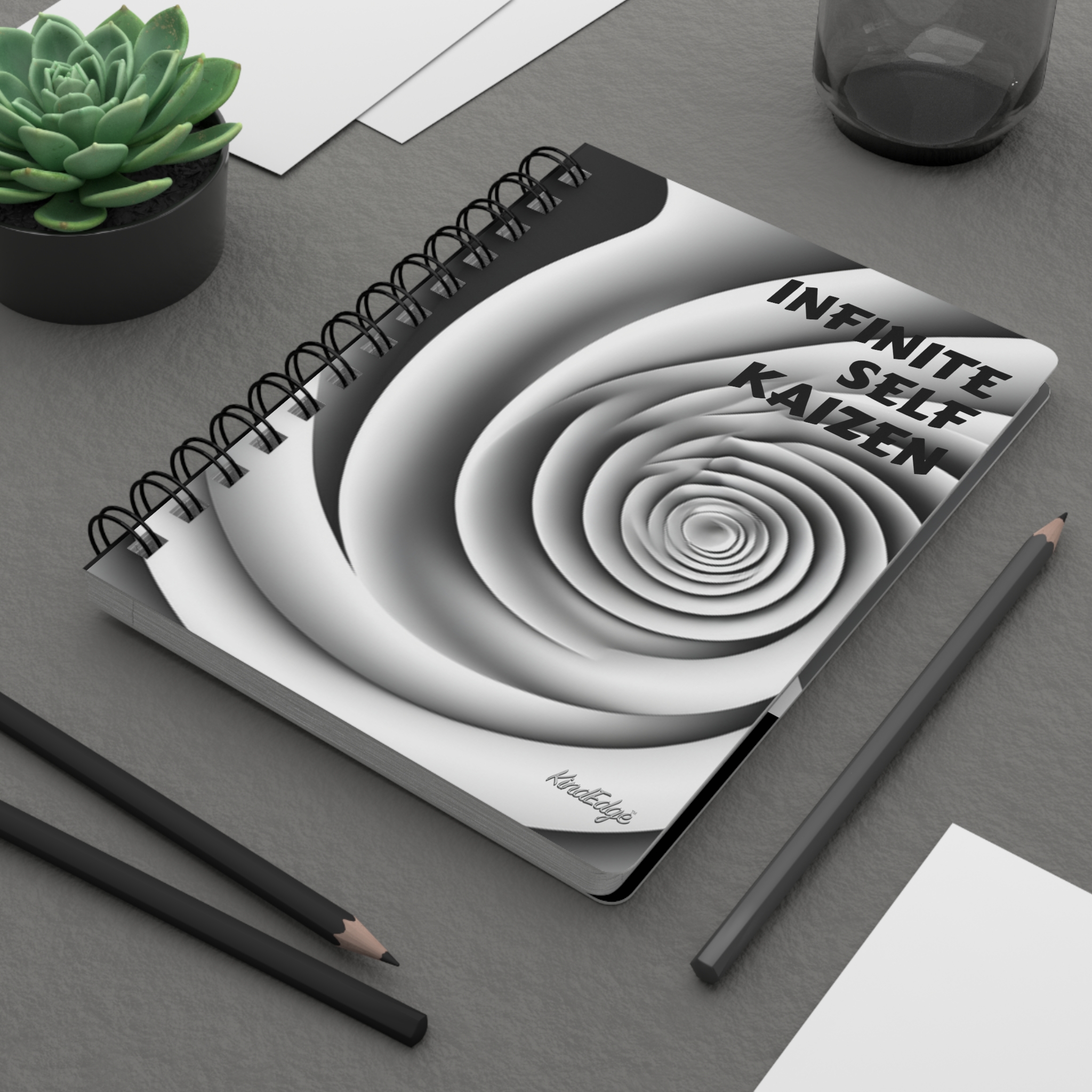
Here is the problem with any mindset shift: it evaporates at the first real obstacle. You understand infinite self-kaizen on a Tuesday afternoon. By Thursday morning, when the first thing went sideways, your brain has already defaulted back to its oldest groove: the self-critical voice, the this-is-never-going-to-work conclusion, the quiet shelving of the goal for another day.
This is why the physical object matters. Not as a decoration. As a circuit breaker.
The KindEdge notebook is built to do this specific job. On the front pages, the major mindset anchors: clarify your goals, unchoose the noise, consciously curate, own your right to unleash the goal idling in your mind. On the back, the reminder of what the Project of You is and what you are working toward. In the middle, the workspace where you run the experiments and track the results.
The object sits on your desk. When the old groove fires and the familiar story starts playing, the object is there. It speaks louder than the default. It brings the wise version of you into the room before the old default has fully taken over. You do not have to fight the default. You just need something in your physical environment that is louder.
That is what a totem is. Not inspiration for inspiration's sake. A physical anchor for the mindset that actually gets the work done when the day is hard and the old wiring is trying to run the show.
You Are the Transmogrifier in Chief
Here is the title I have given myself, and I want to give it to you too: you are the transmogrifier in chief of your own life. You are the chief officer of change. No one else can drive this transformation. No plan can do it. No perfect timing can do it. No guru book can do it for you on the days it counts.
What can do it is a zero-judgment practice of daily action, daily reflection, and daily course correction. One experiment at a time. One result read honestly. One adjustment made without drama. Repeated, indefinitely, for as long as you are alive and building.
That is the players-win-over-planners principle. Not because players are reckless and planners are cowards. Because players are in the game, where the real information lives, and planners are still on the sideline waiting for conditions that will never be perfect enough to justify stepping in.
Get in the game. Run the experiment. Do what works. Join me at kindedge.com. It is not going to be easy. But it is going to be fun.
Come experiment withus. kindedge.com/subscribe
The latest video iswaiting for you at youtube.com/@kindedge