



Your life will feel better, lighter and more in flow when you make the changes you know are needed. Think about what changes you could make in your day today that would get you your true purpose and your true passion in motion. Consider how it would feel tomorrow, and the next day to be driving all your energies into the things that naturally re-energize you, the things that just “click” in your brain and make you feel like you are finally expressing that cool, quirky bespoke part of you that’s been begging to get out into the real world.
When you are working toward a new goal or venture in your life, every simple act requires you to field hundreds more decisions, comparisons and questions. Is this the right way to get a bank loan for my new business? Who should I call next? Is this the way other people start a business? Am I being ridiculous if I push harder after a rejection? Or am I being the hero I want to become, following in the footsteps of the most successful founders and innovators I’ve studied? Which step do I do first? What will everything cost in the end? How do I know who to trust?
It is a strenuous but worthwhile mental, emotional, and physical climb every day. While everyone else is out there doing known tasks on repeat, like walking at a zero-incline on a treadmill, you must force yourself to huff and puff on your steep march upward just to keep pace.
KindEdge is a system that delivers practical, doable step-by-step guidance on how to get your dream or goal in motion. And one of the most critical parts of keeping that Project of You in motion is to ensure the foundation of your life is rock solid, to ensure you will not lose your stamina when the going gets tough. We do a KindEdge360 set of exercises to ensure that you are literally fit for change, physically, mentally, emotionally and systematically. We test which systems work for you to ensure that your journey will remain sustainable. You don’t want to sprint forward when the starting gun goes off, only to bonk soon after when unexpected fatigue and exhaustion get the best of you.
Time Out: If you’re in a rush and can’t read on, why not save these two related videos to your Youtube watch later playlist and then you can head out the door while listening to some tips that have the potential to be useful to you today.
So here are some practical tips that will help you fortify the foundation as you embark on this tough but paramount endeavor.
Tip 1: Build in more breaks.
In the past, you were able to cruise on autopilot because so many of the tasks you were doing were predictable. You may have had a habit of working straight through lunch and well past five p.m., zooming through all your normal meetings and workflows.
When you are venturing into something new, you can’t expect to maintain the same pace. Your brain is working double time to process all the new information and figure out where to file it in your head. You need much more time in the evening for your brain to do a huge defrag and make useful connections between all the various new data points you’ve gathered. Let your brain do its thing; just give it some restful time in which to do that.
Your body needs just as much time for recovery and rebuilding of needed stamina. You might successfully step out of your comfort zone one day to give a big, bold presentation as you vie for funding for your startup idea. But don’t expect yourself to be at maximum productivity for the remainder of the day thereafter. Build in time to come down from all that adrenaline-fueled focus. Plan to break away from the grind to take a walk outside in nature or to sit in an inspiring bookstore and write your reflections in your journal.
These moments of recollecting and reconnecting with self are vital parts of the overall system that keeps the machine that is you running.
Tip 2: Plan for real, not ideal.
Human productivity naturally ebbs and flows in 90-minute cycles called ultradian cycles. Andrew Huberman has discussed this concept and has written about it here. Instead of fighting these natural ultradian rhythms by trying to power through a long marathon of taxing brain work, make use of your body’s natural rhythms to context switch and do some completely divergent, turning to a task that uses a different type of thinking, or no thinking at all. As you plan your day, assume that every 90-minutes-ish you will pop your head up like a little gopher and scurry off to something new. Midday your body might want to play, doing some exercise, or meeting up for a quick game of pickle ball. And at other points in the day you might find a coffee break is what you need, or even just an indulgent deep dive down an internet rabbit hole to explore a fun topic you’re interested in.
Here is a great example of a day planned out to best accommodate your natural ultradian rhythms.
Tip 3: Preserve your energy.
Don’t wait until your tank’s empty. Even if you’re not yet passing-out exhausted, give yourself permission to take breaks early, before you hit the wall. This approach makes it far easier to return to the work that day or the next morning. When you let yourself completely crash, it takes much longer to build up your mental resolve and get your normal excited, energetic positivity about the work you are doing running again.
Keep yourself wanting it, and you’ll eagerly return to the hard day after day.
Tip 4: Make no comparisons.
Do not compare how you are showing up today, or how much progress you’ve made, to yourself in the past nor to anyone else.
The complexity of what you are doing is not going to let you keep any sort of consistent pace. There could be times wherein you plan to get ten things done in a day, but one thing turns out to be so complex that it consumes the entire day and rolls into the next.
This entire pattern is part of the process to help you learn about you and about the truth of this work. Sure, in the past when you were just writing screenplays as a hobby, you were able to pump out eight-hours of writing easily. But now that you’re treating this as your new profession, you find you can only do about three hours at a time before your brain is drained. This is because along with the creative work of writing a story, you are also using the judging side of your brain to ensure you are adhering to the many formal story structure requirements and the detailed and rigorous formatting demands of a truly professional screenplay.
When you first planned for this work you imagined yourself rolling along, “weeeeeeee!.” But now you are noticing so many unexpected jagged edges as you fold in the new considerations that come along with your hopes of actually getting paid for this work.
It’s OK! Do you. Learn you. Plan for you. Take notes on what works, and throw out what does not. In KindEdge we call this Infinite Self-kaizen. No judgment. Just observation of reality, running new experiments and keeping only what works for you.
There is nothing around you that can be compared to you while on this journey. Every day you are gaining all the on-the-ground experience you wanted. You are making it real, filling in the blanks that you just didn’t know when you set off on this journey.
Tip 5: Do one thing at a time.
Your master plan contains hundreds of equally-urgent parallel tasks. How do you pick just one?
In each evening, plan some wrap-up time into your schedule. Each night scan through the next blob of open tasks and think about the macro intent of the work you are doing. Hunt down the tasks that will make the greatest impact on getting a bigger process going or that will relieve a bottleneck. Then look for tasks that you can group and turn into a system that runs continuously.
This framework enables you to select your focus for the next day without getting stuck in the one-off whack-a-mole mode that makes you feel anxious because no matter what task you dig into, you feel like you are neglecting the twenty other parallel tasks.
When you have finally defined your “one thing” to focus on tomorrow, give yourself permission to do just one thing. Your brain will keep nagging at you, saying “but all the other things need to get done too!” Feel secure that by locking down your one next thing, you are laying down a few big bricks that will, over time, build the foundation of your masterpiece.
Tip 6: Don’t be a know-it-all. Use your KindEdge Board of Trusted Advisors.
Phone a friend. And do it sooner vs. later.
You’ve Googled your question. You shared your conundrum with Gemini, ChatGPT, and Claude. You’ve explained the complexity to Perplexity. You handed off your mental block to Grok. You even let Mistral and DeepSeek duke it out, but you still ended up with no declarative decision.
As you shut down your computer for the day thinking “I’ll just have to do more of this tomorrow until I find the answer” you might want to take pause to pull out your KindEdge Steps notebook.
Remember what we did in Step 2? Remember that awesome, diverse, made-for-you Board of Trusted Advisors we built? The one that has someone for every type of problem, from business, to personal, to finance to spiritual, to motivational needs and more? Phone one of them now! This is what they play for! These are the people who are in your corner and would love to help you get unstuck from running in circles.
When the answer you thought you were looking for turns out not to be the right type of solution, your Board of Trusted Advisors will be there to help you zoom out to the 30,000-foot view to recalibrate your approach.
Tip 7: Use your KindEdge clarity on Big Rocks and Choices
You know the steps we worked so hard on, the ones where you had to check your gut, check the reality of your current life’s focus, and then get real about all the other distracting choices out there that you’ll need to say “no” to in order to give your goal a real fighting chance?
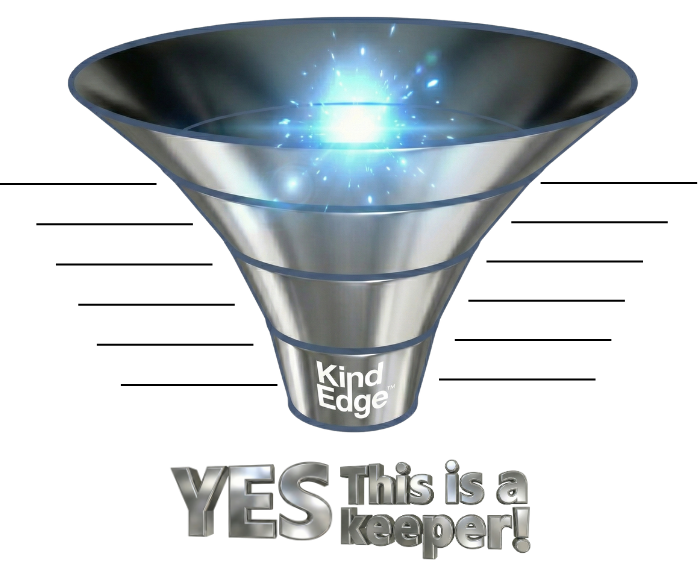
This is where that becomes useful. You use your “purpose filter” (look in your KindEdge notebook again, it’s there!). And look at your KindEdge Big Rocks folders. These are the things that, back when you had no distractions and you had absolute clarity, you said were the absolute most important. You documented them as part of your commitment to invest your time in those priorities, above all else. And we practiced saying “no” to other invitations, ideas and opportunities that might be interesting or positive, but that simply could not fit within your Big Rocks Binder shelf for this chapter of your life.
So now is the time to use all those tools. A group of friends begs you to join their triathlon team, or venture out on their Mount Kilimanjaro challenge, or start playing in their weekly mahjong club. They all sound great, so make note of those ideas in the “Great Ideas But…” binder that sits to the side of your Big Rocks.
They are not forever lost. They are just not your Big Rocks for now. And you get to show proud respect for your Big Rocks by saying “Kind thanks, but no. I’m dedicated to seeing my current project through to the end because it’s a vital expression of me.”
As you work on this new muscle of saying no, prepare in advance so you don’t get triggered to immediately respond “yes.” Practice a new default response such as “I have a lot already queued up, but let me check and get back to you.” And when you do allow things in, ensure that you have only one “wildcard” per week and commit to that being your limit. Respecting your Project of You requires that you dig in a completely new groove wherein it becomes your new normal.
Tip 8: Crowd out distractions by using time blocks in your calendar
Hijackers can’t take over your day if you don’t let them. Add time blocks for all your priority activities in your calendar in advance and on repeat. When needed, shuffle them around, but don’t delete.
Tip 9: Play offense with your new energy
When you preserve your energy this masterfully, look at all the cool things you’ll have the kahunas to do:
- Wake up with your engines revving
- Bravely negotiate new personal finances to buy you more time and more financial flexibility
- Fiercely advocate for your ideas when you apply for a business loan
- Creatively use advertising tools to maximize their effectiveness
- Excitedly discover huge benefits of using new writing software
- Boldy write big checks while protecting that investment and sleuthing out ways to save
- Unabashedly ignore boneheads and @$$hats who used to siphon away your time but who don’t respect your higher purpose
- Reinvent yourself, and present yourself, as one who is doing the thing, not just thinking about it. You are a screenplay writer, you are an entrepreneur, you are a triathlete, and you are a charity founder.
These tips for preserving your energy to achieve your greatest goals are critical life skills that you can take with you and make use of forever. I hope you will join me on this KindEdge journey! It’s a journey that is not gonna be easy, but it’s gonna be fun.
Cheers, cin-cin, and hugs,
MarySueIRL
PS: Do the Dumb-smart Stuff First
Here are notes taken from one of the videos I mentioned above. You can perhaps consider it a bonus tip. It explains how you can gain momentum and better productivity by doing the dumb-smart tasks first.
Do the dumb-smart stuff first. You always imagine you have to master all the big complicated stuff immediately up front or you’re failing. But really, if you’re dreaming of some big goal and the whole endeavor seems too huge or overwhelming, start with the smallest, most actionable thing first.
Don’t have good training gear to achieve the iron man you dream of finishing?
- Start with the lowest hanging fruit: Put on your old worn-out tennis shoes and run a few miles while listening to podcasts by expert ironman athletes about what gear is needed to get started.
- Then you’ll have awesome mental momentum when, after your run, you drive down the street, walk into a sports store and buy all the expert gear.
Want to start a consulting business?
- Before you build a website and set up bank accounts, reach out to 5 old business contacts and schedule back-to-back coffees with each of them. The notes you collect will help you pre-filter choices, narrow your focus and get clear on the best first action.
Look for any small morsel of dumb-smart tasks that you can do immediately so you begin to feel the momentum. It’s so critical for your brain to see evidence of action and results. That little positive feedback helps your brain see it as a dopamine source, and your brain will then do the work of pushing you to return to the next stop tomorrow morning.
As you work to achieve big life change, any pile-up of complexity that your brain perceives is bound to slow you down. Yet much of that complexity is not real; it is only perceived. But it looks like an insurmountable wall to your brain nonetheless.
So take a look at things you are struggling to get in motion and hunt for the dumb-smart tasks and knock them out.
And here’s another hack. When the remainder of that list is just too long, and you know it just won’t get done, before you toss it in the trash, do the next dumb-smart thing with it. Throw a Hail Mary as if letting the gods decide if there are any takers for those tasks.
For example, let’s say you have no time to get your complex set of tax documents organized for your accountant like you usually do. Before you throw away that list and those intentions, wouldn’t it be dumb-smart to toss that list to your accountant and see how much he and his team could wrangle for you?
And isn’t it possible that even if this means you’ll end up paying an extra $500 in accounting fees, won’t you make more than that by continuing to work chargeable hours for your business client?
You are likely to encounter hundreds of daunting to-dos like this that you could knock out with a dumb-smart Hail Mary of any kind. Hail Mary’s are not always about paying someone to solve the problem. Sometimes just by batching together like items you can see ways to knock them out as a group, killing two proverbial birds with one proverbial stone. (That phrase just sounds so barbaric, does it not?)
Anyhoo… Here's to you. Keep it simple and do the dumb stuff the dumb-smart way to simply stay in motion on your path to bigger things.