
It's DEXA Day — and It's My Favorite Day of the Year
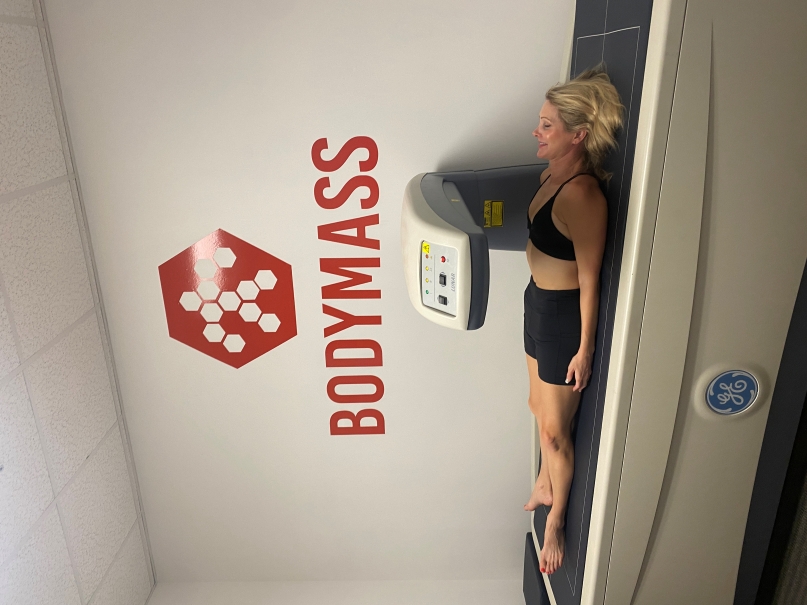
Once a year, my younger son and I go for a DEXA scan. When my older son is not in England working his F1 motorsports career, all three of us go together. We make a day of it. We drive to Tampa, get the scan, and spend the drive home digging through the data together, connecting what we see in the numbers to everything we have been doing over the past year.
This is not the DEXA scan your doctor prescribes to check your bones. This is a private, self-paid body composition scan: lean mass, fat mass, visceral fat, organ fat, bone density, all of it mapped visually, region by region, year on year. It is the most useful data I have on my health. Nothing else comes close.
Why Weight and BMI Tell You Almost Nothing
I want to start here because it is genuinely important and the medical establishment has largely failed people on this point.
A nurse once looked at my results and said: oh, you gained a little weight. You might want to lose that. I had gained lean muscle mass. She was looking at the scale number and telling me to get rid of muscle. I was floored. This is a medical professional treating a meaningless proxy metric as if it were health data.
Weight is not data. BMI is not data. They are numbers with no context. Here is what they cannot tell you:
- Whether what you gained or lost was muscle, fat, bone, or water
- Where in your body fat is distributed (visceral fat around organs is metabolically very different from subcutaneous fat)
- Whether you are gaining muscle in the areas you are training
- Whether your bone density is improving or declining
- Whether your body composition is moving in a direction that supports longevity
You can gain five pounds of scale weight and be dramatically healthier. You can lose ten pounds and be in worse shape than before. Without body composition data, you are flying blind.
The DEXA scan gives you the actual levers.
What a DEXA Scan Actually Shows You
A private DEXA scan (not the bone-only version your doctor orders) gives you a full body composition map:
- Total lean mass in pounds, broken down by region: arms, legs, trunk, and total
- Total fat mass, separated into subcutaneous (outer) fat and visceral (organ) fat
- Bone mineral density, with year-on-year trend comparison
- A visual body map showing exactly where fat and lean mass are distributed
- Asymmetry data: how your left and right sides compare, which can reveal training imbalances
That asymmetry data is genuinely fascinating. My legs are exactly 17.1 pounds of lean mass each, perfectly matched. But there is about 3% more fat in my right leg than my left, and I am right-handed. I do not know yet whether dominant-side use sends more fat there, but it is a question the DEXA scan opened up that I never could have asked from a scale.
My son, who lifts heavy, had about a pound and a half more lean mass in one leg than the other, despite training them equally. The dominant leg gets a slightly larger training stimulus and grows faster. The scan made it visible.
The Over-50 Reality: Why You Have to Train Like You Want to Be a Bodybuilder Just to Maintain
I am 53. And here is the truth that nobody tells you about aging and muscle: by the time you are over 50, the work you have to put in just to maintain your muscle mass is the same work a younger person would put in to build it. You are working as hard as if you want to be a bodybuilder, and the outcome is maintenance.
This is not discouraging. It is useful information. It changes how you approach training entirely.
The reason is hormonal. When you are young and your growth hormone is surging, your body absorbs protein and amino acids efficiently and builds muscle readily. When you are older and hormone levels have declined, you absorb less from the same input. You need more protein per meal to achieve the same muscle protein synthesis. And you need harder, heavier, more challenging exercise to provide the stimulus your body needs to bother building anything at all.
Cardio is not enough. Walking is not enough. You need to be lifting heavy, doing strenuous compound movements, challenging your fast-twitch and slow-twitch muscle fibers. Hot power yoga counts. Ballet with ankle weights counts. Heavy weightlifting counts. They have to be genuinely hard. The body has to receive a clear signal: we need this muscle and we need it to be strong.
The Muscle You Build Young Is the Muscle You Live On Later
This is why I tell my sons to take their training seriously now, not later. The muscle you build in your twenties and thirties when your hormones are abundant and your protein absorption is efficient is the foundation you will be trying to maintain in your fifties and sixties. You cannot go back and build it retroactively.
If you do not maintain muscle, here is what happens: you trip. And when you trip, you may not have the fast-twitch reactive strength to catch yourself. And if you fall, you may not have the bone density to survive it without fracture. And a broken hip is not a minor inconvenience. Thirty percent of people who break a hip die within a year, from complications, from the inability to be mobile and independent, from the systemic decline that follows.
Strong muscles and dense bones are not vanity. They are the physical infrastructure of a long, independent, capable life.
What I Changed This Year and Why the Data Confirmed It
Last year's DEXA scan showed I had put on some fat even though I was training hard. I spent the year figuring out why.
I identified two likely culprits. First: I was eating fat bombs at night, dense pure-fat carnivore snacks intended as electrolyte sources. Second: I was taking a specific mix of individual amino acids as an evening supplement. The amino acids were labeled as ketogenic, meaning non-glucogenic, meaning they should not spike insulin. But apparently some of them were driving a glucogenic response anyway, quietly telling my body to store fat at night.
This year I cut both. I stopped the evening amino acid powders entirely. I stopped the fat bombs. I simplified my approach: one high-protein meal per day, eaten after training, kicked off with a specific trigger amino acid that signals to the body that there is a full bolus of protein available and that now is a good time to build and repair muscle rather than conserve.
The concept is essentially: your body's default is conservation. Building muscle is the most energetically expensive thing it can do. It will not do it unless it receives a clear signal that resources are abundant. The trigger amino acid is that signal. It says: we just caught the lion. We have plenty. Build.
The result this year: I grew lean mass. As a woman over 53, I grew muscle. One pound of new lean mass in the glutes specifically, from exercises my son showed me. Several additional pounds of lean mass overall. And my bone density improved against a trend line that normally runs the other way.
The KindEdge 360 Case for Treating Your Body Like a Religion
Here is why all of this connects to the Project of You, to big life change, to every goal you are trying to achieve.
Your body is the only machine you get. Not an iPhone you can upgrade. Not a car you can trade in. This one machine. And everything you want to do, every hard conversation with an attorney, every pitch meeting for the charity, every negotiation with your employer, every early morning when you have to choose the big goal over the easier default, all of it runs on this machine.
I truly believe I did not fall into depression through some of the most difficult seasons of my life, hurricanes flooding my home, years of legal battles, personal losses, because the foundation was solid. I knew what I needed, I slept deeply, I trained hard, I ate in a way that kept my blood sugar even and my energy stable. A flat tire on the way to an appointment registered as a thing to handle, not a catastrophe, because I felt good. The baseline made the hard things manageable.
That is what the KindEdge 360 physical foundation is actually for. Not to look a certain way. To have the machine running well enough that the rest of your life can happen.
Go get the data. It is so much more interesting than you think.
Join a community of people who aren't waiting for the dream they crave. We're taking stupid-easy daily actions that get things moving in real life: kindedge.com/subscribe
And if you're multi-tasking but want to carry on, just pop over to the latest video about your journey—The Project of You—to unlock the alternate ending to your life: youtube.com/@kindedge